

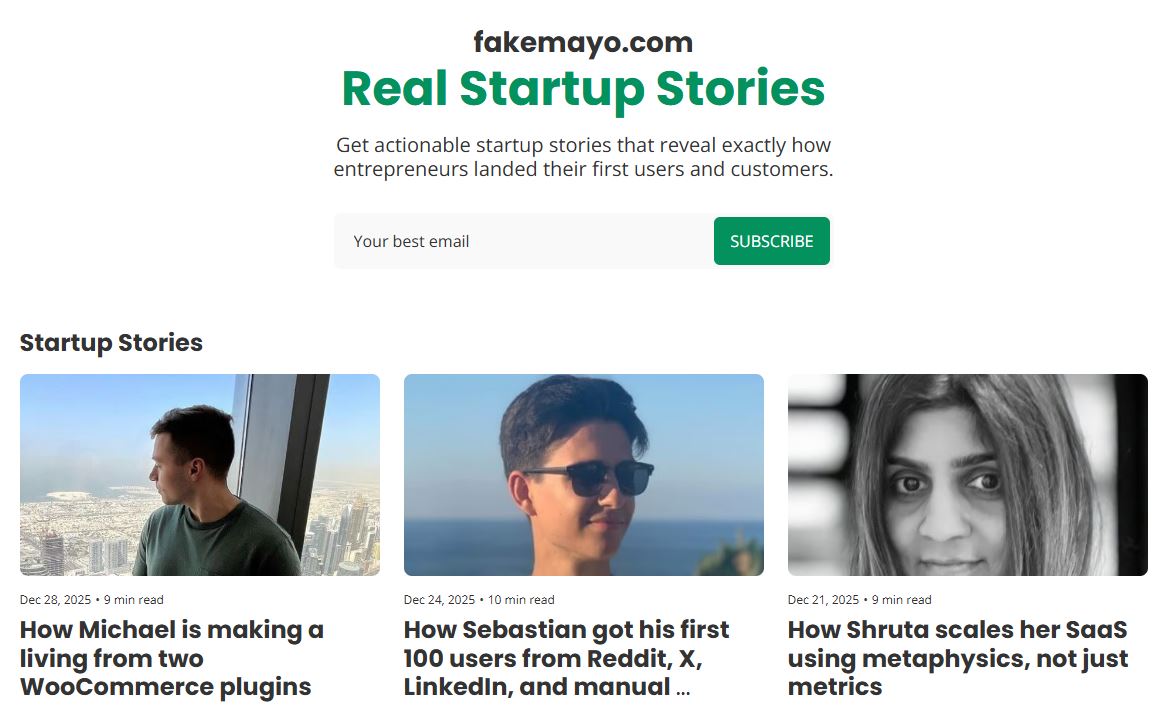
Real startup stories revealing exactly how founders got their first users and customers.
About
Fake Mayo is a dedicated digital publication and newsletter engineered for entrepreneurs, side-hustlers, and indie hackers seeking to decode early-stage startup growth.
The platform bypasses generalized business theories and late-stage venture capital hype to shine a light on the grueling "zero-to-one" phase of building a company. It delivers deep, long-form operational breakdowns exposing exactly how modern builders source their initial audience.
Core Editorial Value and Philosophy
The fundamental goal of the Fake Mayo newsletter is to act as an unglamorous blueprint archive. Most mainstream tech media platforms highlight massive funding rounds, multi-million dollar acquisitions, and executive restructurings. In contrast, Fake Mayo interviews ordinary solo founders, software developers, and non-technical builders who are actively grinding in the trenches. It forces interviewees to dissect the specific tactics used to sign up their first 100 users, generate their first $1,000 in monthly recurring revenue (MRR), or navigate early product failures. The content strips away marketing buzzwords to present raw distribution strategies.
Practical Case Studies and Real Metrics
The articles on Fake Mayo function as text-based masterclasses on organic traction. Each edition profiles a specific creator and maps out their timeline, conversion metrics, traffic channels, and tech stack. Instead of vague declarations like "market your product," the articles disclose precise step-by-step methods. Readers learn how founders leverage platforms like Reddit, X (Twitter), LinkedIn, and hyper-targeted cold outreach to gain traction without a marketing budget. Featured stories span a diverse technical landscape, covering solo developers building Tailwind CSS platforms, non-technical founders launching profitable meme engines via no-code tools, and independent builders engineering niche SaaS platforms.
Who the Newsletter Benefits Most
The publication is uniquely valuable for individuals who feel overwhelmed by traditional corporate frameworks or gatekept by venture capital standards. It serves as a tactical handbook for bootstrappers who must rely entirely on their own resourcefulness to acquire users. By analyzing the authentic stories of other builders—including their conversion rates, monetization missteps, and product pivots—subscribers gain a realistic look at modern software distribution. The publication shifts the focus from simply writing code to mastering distribution from day one.